
The Promise of the Starlight Teapot
A warm tale about Minjun, a boy who wants to save his family’s old teahouse and follows the secret of a starlight teapot to bring his family back together.
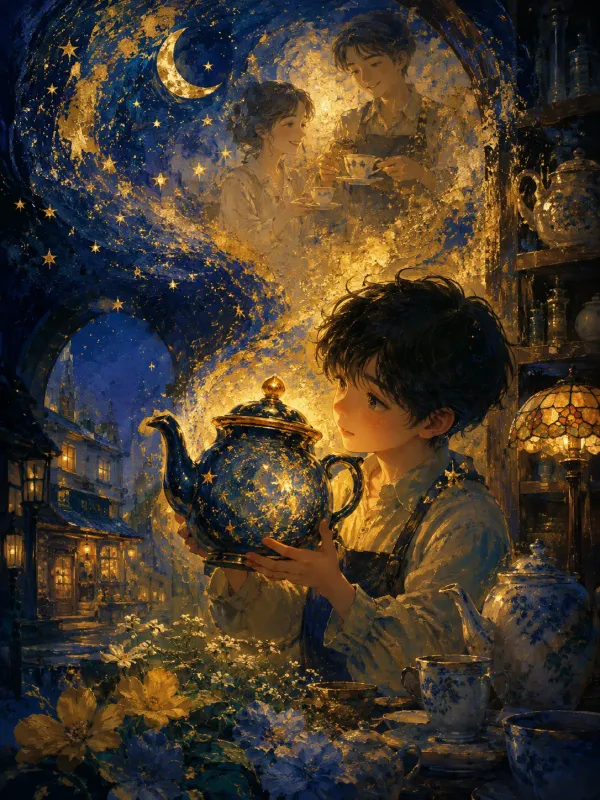
Minjun was eleven, and he liked fixing things more than racing after them. When a soccer ball flew over a wall, his friends ran first, while Minjun picked up the loose screw under the bench and slipped it into his pocket. His home was a small teahouse at the end of a hillside street. On the sign, faded golden letters read Sogon Teahouse, and when the wind blew, the sign gave a tiny ring, as if someone were whispering a secret.
Sogon Teahouse had been opened by Grandmother when she was young, then passed to Father, and warmed by Mother with the smells of cinnamon and jujube. But lately fewer customers came, and Father tapped at his calculator every night with a sigh. Minjun knew that sigh stayed around like tea stains at the bottom of a cup. One evening, he heard Father speaking to a real estate man on the phone. ‘I suppose I should think about selling. ’ The words slid through the crack in the door and sat cold in Minjun’s chest.
To Minjun, Sogon Teahouse was not just a shop. It was the window seat where Mother used to read to him on rainy days, and the place where Grandmother remembered people’s troubles before she remembered their names. Mother had been gone for two years, but on the inner shelf still sat the star-patterned teapot she had loved. Its blue porcelain was scattered with golden dots, and a little moon-shaped handle rested on top of the lid.
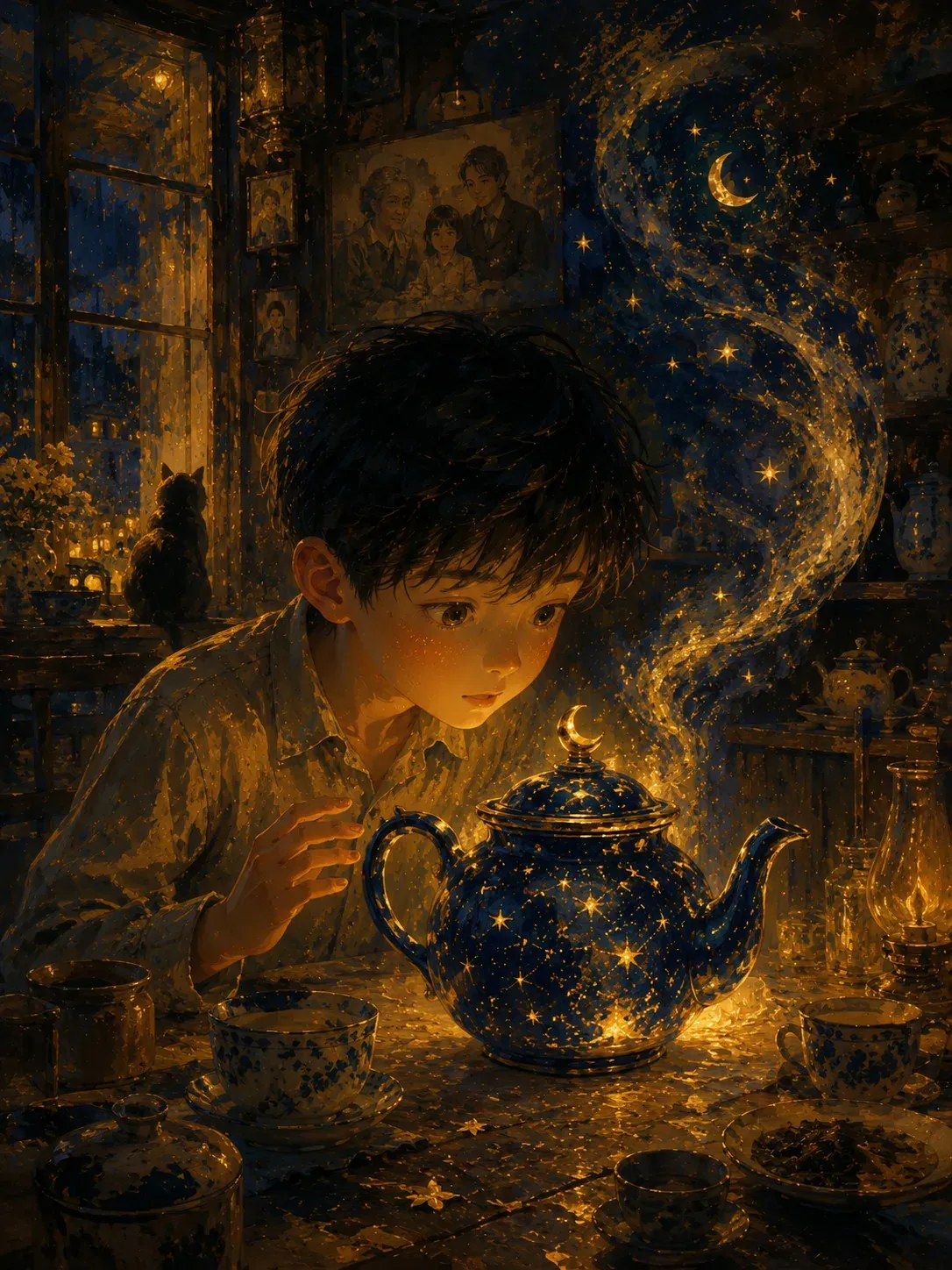
That night, unable to sleep, Minjun went downstairs into the teahouse. The stove was out, and the dry scent of tea leaves mingled with the old smell of the wooden floor in the dark. When he stroked the star-patterned teapot, one golden dot glimmered like a firefly. Minjun jerked his hand back. Then a very small whisper came from inside the pot. ‘Find the lost promise, and the house will grow warm again.’
Minjun could not tell anyone about it by morning. Father was washing rice with a tired face, and his older sister Jian packed her schoolbag with her earphones in. At the table, there was more clinking of spoons than conversation. Minjun secretly put the teapot into his bag and went to school. Even during lessons, the lost promise rolled around in his head. Was a promise a thing, a sentence, or perhaps someone’s heart?
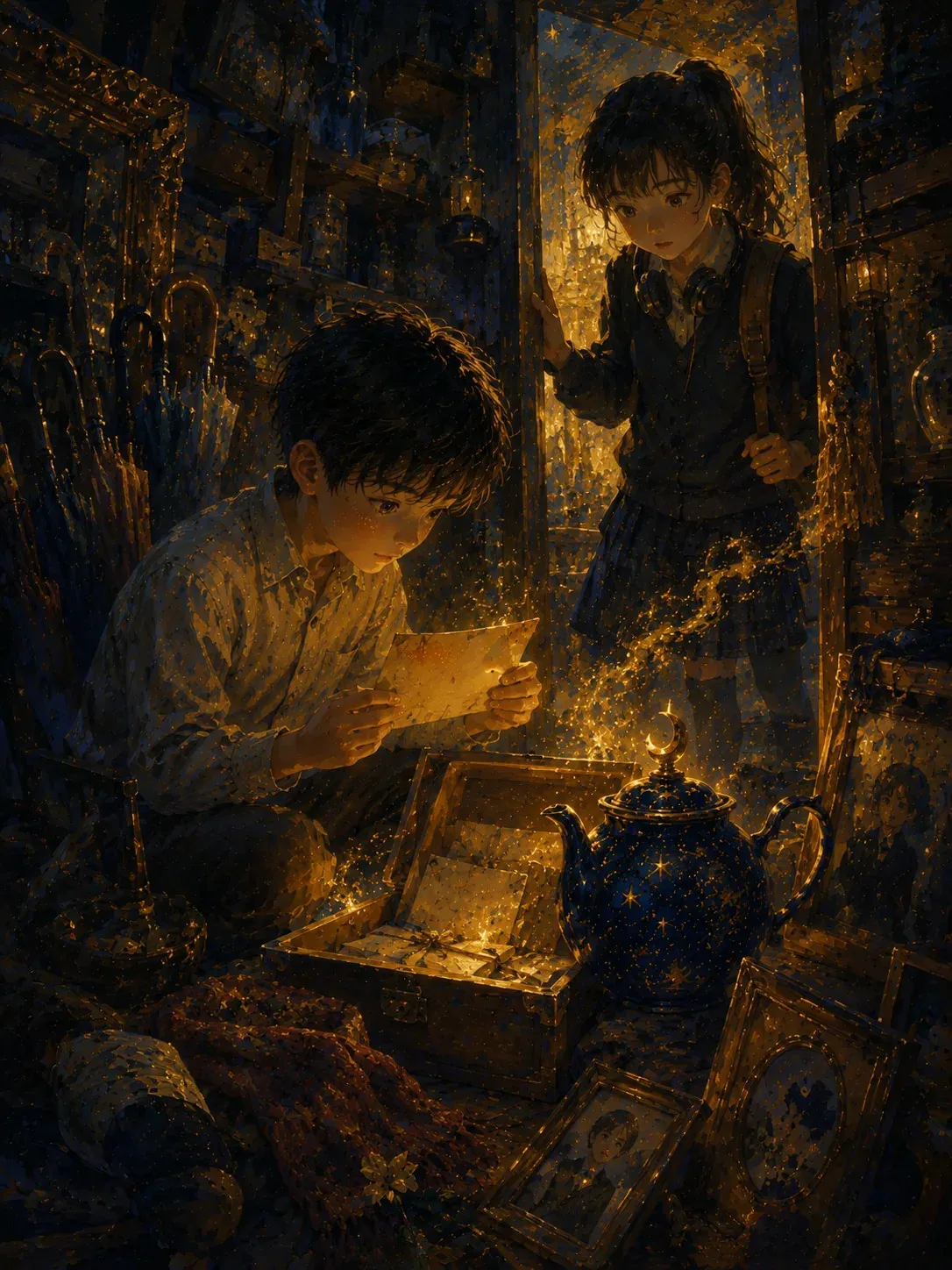
After school, Minjun went not to the library but into the teahouse storage room. Old chairs, cracked frames, Grandmother’s wool scarf, and umbrellas left behind by customers slept there in the dust. The star-patterned teapot glowed faintly again in the storeroom shadows. When Minjun searched behind a shelf, he found a thin wooden box. Inside were old receipts and a bundle of brown letters. On the top letter, in Mother’s handwriting, were the words: To be opened together before Minjun turns twelve.
Minjun held his breath. The letter was sealed, though one corner was stained by tea. He sat for a long time between wanting to open it and not wanting to break the promise. Just then, Jian flung open the storage room door. ‘What are you doing in here? ’ Minjun hid the letter behind his back, but Jian noticed at once. After staring at it in silence, she took out her earphones and said softly, ‘That’s Mom’s handwriting.’
The two of them decided not to open the letter yet. Instead, they unfolded the small map stuck to the bottom of the box. It showed the hill behind the neighborhood, an old well, a ginkgo tree, and Sogon Teahouse, all drawn by hand. Beside the ginkgo tree was a star and a sentence: Before the first frost of winter, find what the family buried together. Jian bit her lip. ‘Do you remember? That day we went up the hill with Mom. ’ Minjun remembered dimly too: the smell of soil, Mother’s red gloves, Father’s laughter.
That evening, Minjun showed Father the map. Father’s face stiffened. He folded the map and placed it on the table. ‘That was only an old game. This is not the time to go looking for things like that. ’ His voice was calm, but its edge trembled. Heat rose in Minjun’s chest. ‘Mom left it for us. Why do you act as if none of it ever happened? ’ Father could not answer, and Jian quietly caught Minjun’s sleeve.
At dawn the next day, Minjun climbed the back hill alone. The sky was ink-dark, and wet fallen leaves clung to his shoes like scraps of paper. In his pocket he carried a small trowel and the star-patterned teapot. The ginkgo tree was larger than he expected, with a few last yellow leaves holding on at the tips of its branches. When Minjun began digging near the roots, a breathless voice came from behind him. ‘Do you think Mom would have liked you coming alone? ’ It was Jian. Behind her, Father was climbing with slower steps.
Father knelt beside Minjun without a word. The three of them carefully dug through the cold earth. Before long, the trowel struck something hard. It was a wooden box. Inside lay a small rusty key, a dried chrysanthemum, and an old little recorder holding Mother’s voice. With trembling fingers, Jian pressed the button. After a crackle of static, Mother’s voice flowed out. ‘If a day comes when our family finds it hard to speak to one another, open this box.’
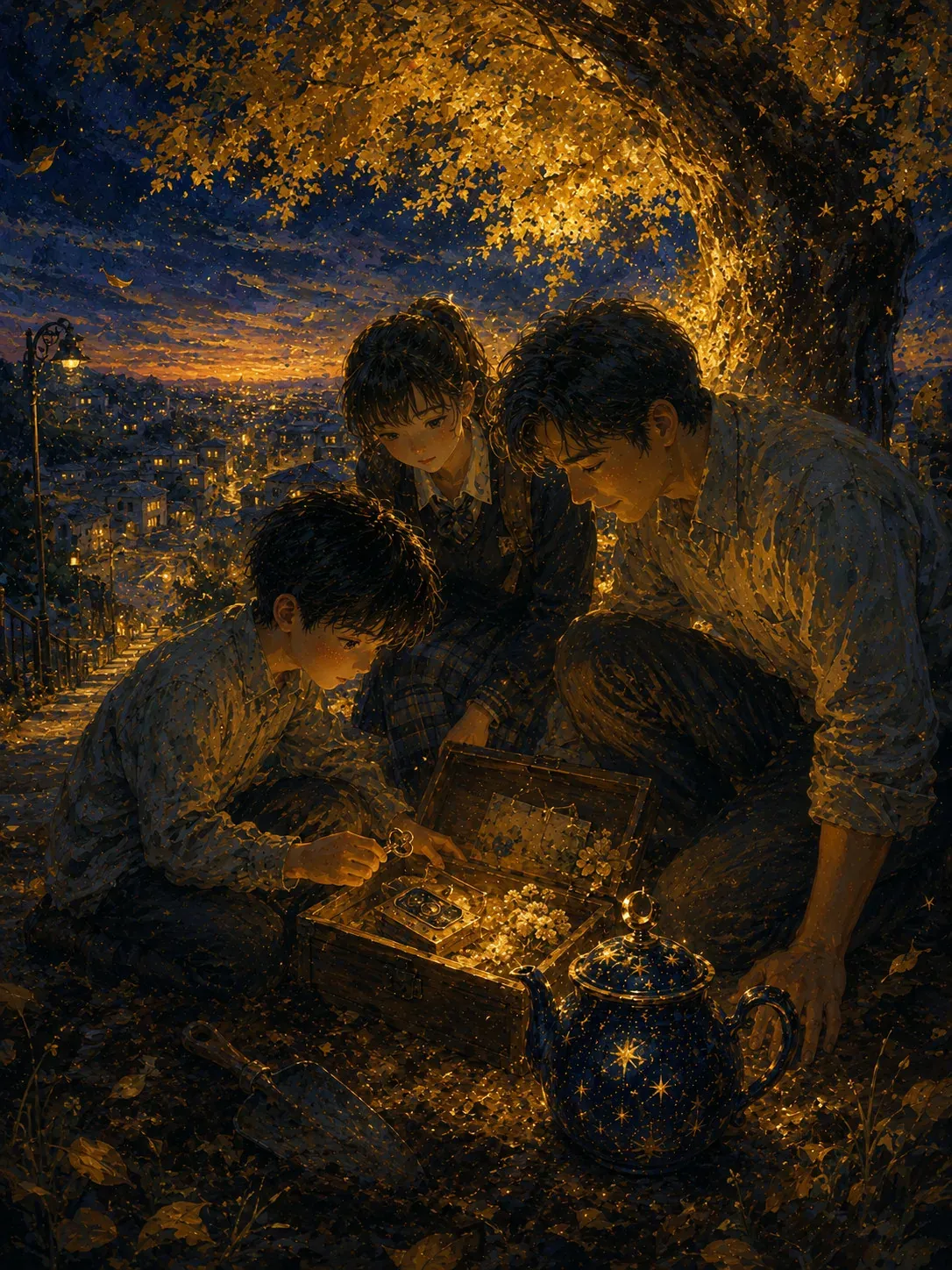
Mother’s voice continued between the gusts of wind. ‘The teahouse is not a building. It is our promise to listen to one another’s stories. But if it becomes too hard, it is all right to sell it. What matters is not keeping the shop. What matters is not closing your hearts. ’ Minjun felt his chest drop. He had thought saving the teahouse was the same as saving Mother. But Mother was telling them that not losing one another mattered more.
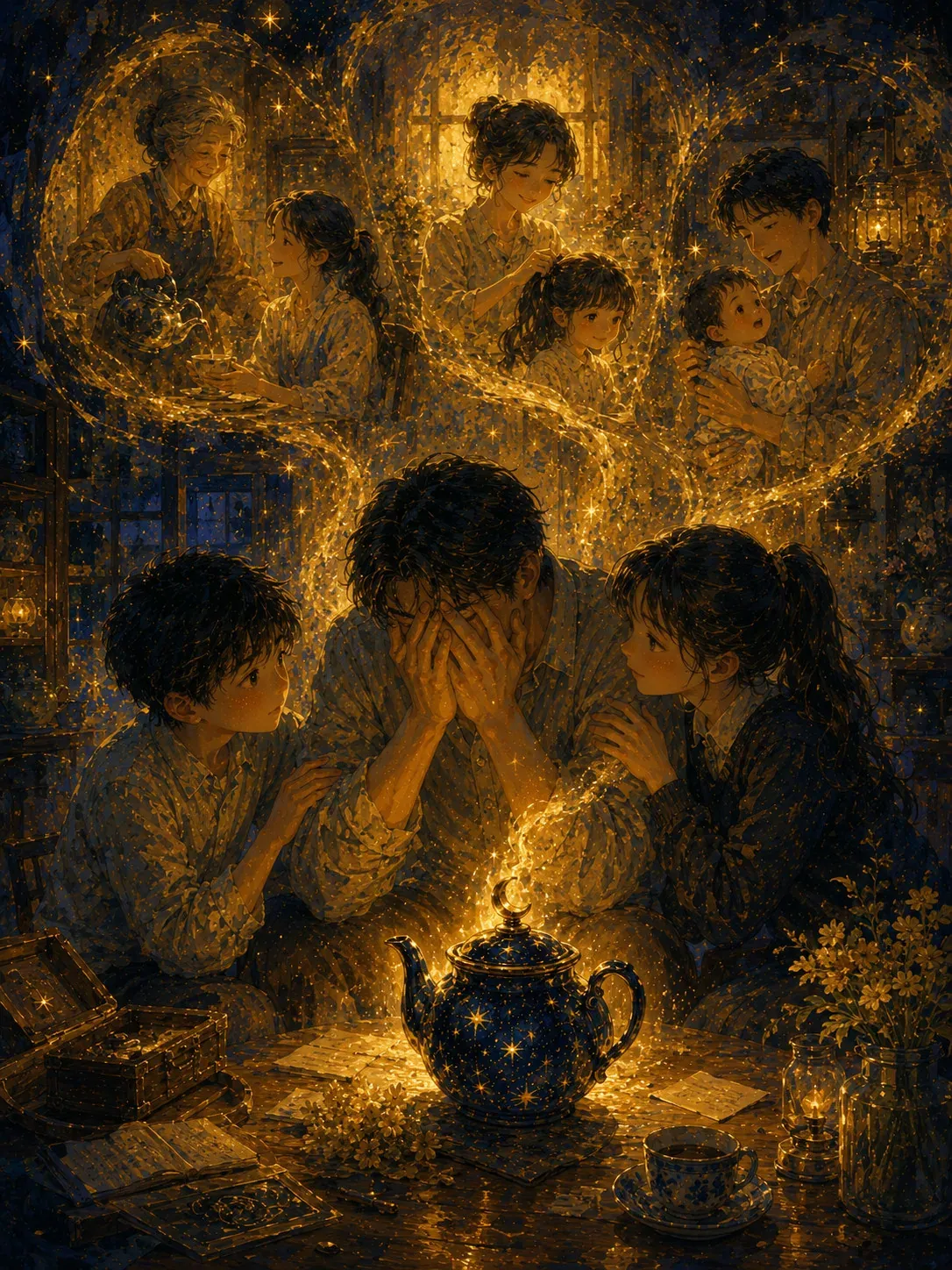
Father covered his face with both hands. After a long while, he said in a low, rough voice, ‘I was afraid that if I heard your mother’s voice, I would fall apart. So I tried to put away the things, the memories, and the words.’ For the first time, Minjun understood that Father had not been angry. He had been frightened. Jian placed a hand on Father’s shoulder. Minjun hesitated, then wrapped his arms around Father’s other side. Their breaths mixed white in the cold air.
At that moment, the star-patterned teapot warmed inside Minjun’s bag. Its lid lifted slightly, and a pale steam-like light drifted out, wrapping around the ginkgo tree. In the glow, they saw days from the teahouse’s past: young Grandmother serving tea to her first customer, Mother tying little Jian’s bangs, Father holding baby Minjun and singing an awkward lullaby. The magic was not grand. It simply returned forgotten warmth to their eyes for a little while. That made it feel more real.
After they returned home, the family kept the teahouse lights on through the night. They did not decide right away whether to sell it. Instead, they cleaned the room that had been shut for too long and opened Mother’s letter together. It held more wishes than recipes. Offer customers a warm seat before perfect tea. Ask family about their hearts before asking about their busy day. Minjun copied those sentences into his notebook.
A few days later, a new paper appeared in the window of Sogon Teahouse. Saturday Family Tea Gathering. Bring an old story. Minjun’s handwriting was a little crooked, but it had strength. Jian posted a photograph on the neighborhood board, and Father brewed Mother’s chrysanthemum jujube tea again. The first guest was the mailman who always lost his umbrella. Next came the rice-cake shop lady and the quiet twin brothers. As people drank tea, they brought out forgotten family stories one by one.
Business did not suddenly become easy. The numbers in the calculator were still careful, and the old floor still creaked. But Father no longer held the calculator alone. Jian prepared a small weekend photo exhibit, and Minjun repaired the broken chairs and wobbly tables. Every night, the three of them shared one last cup of tea and named one thing they were grateful for that day. Sometimes the words were short, and sometimes tears came, but no one left the table first.
On the day the first snow fell, Minjun set the star-patterned teapot by the window. Its golden dots sparkled with the snowflakes, but it no longer whispered. Minjun felt a little sorry, but he understood. Magic could show a path, but walking it belonged to the family. He watched Father pour tea for a customer with a smile and Jian photograph the snow beyond the glass.
Minjun wrapped both hands around his teacup. Warmth traveled through his palms, up his arms, and slowly into his chest. He knew then that Mother’s promise had not disappeared. It was brewing again inside them. The sign of Sogon Teahouse rang softly in the wind. This time, it did not sound like a secret. It sounded like a small bell calling them home.
The End
That is the story for today
Take a moment to talk about the scene your child remembers most.
ADVERTISEMENT